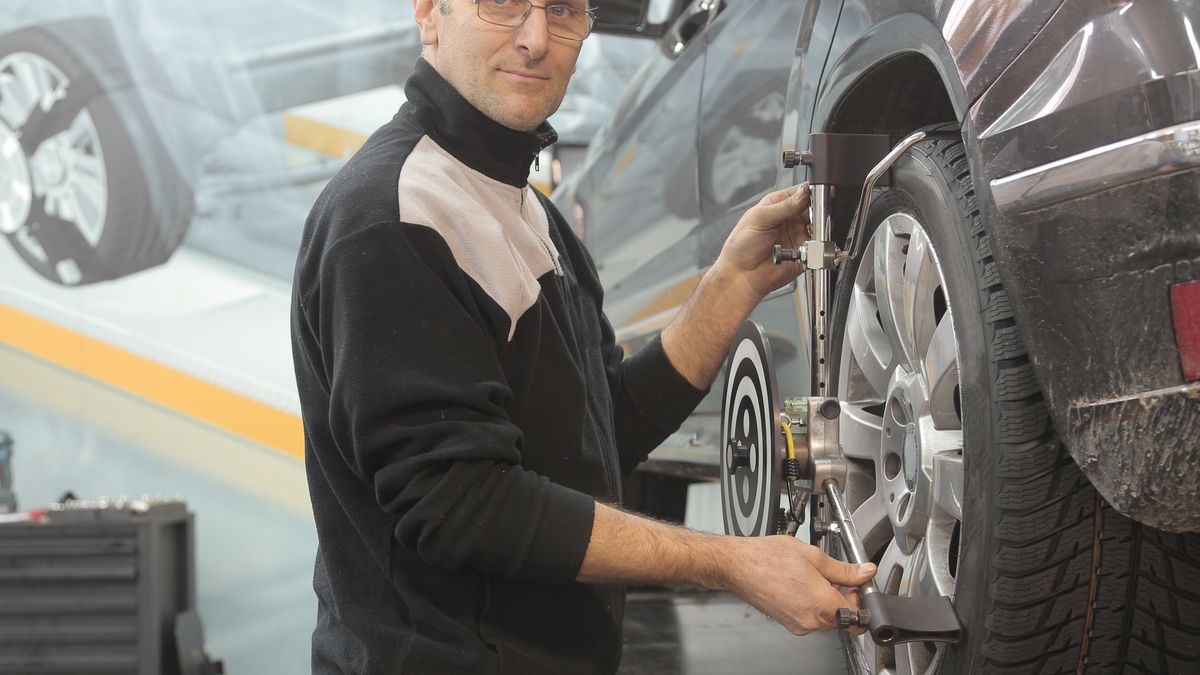
Talk about AI for automotive workshops and the conversation usually ends up watching a robot arm assemble an engine in a factory. That isn't a workshop. An independent garage, a network shop or a dealer aftersales department is a business of diary slots, parts and billable hours — and the software it already owns (the DMS, the parts catalogue, the diagnostic tool) only covers part of the job. The rest runs on the phone, the service manager's WhatsApp and twenty years of a mechanic's judgement.
This guide is about that second part: which stretches of manual work can realistically be automated today with your own data, what each one costs in effort, and where you should leave things alone because the mechanic's judgement is still cheaper and more reliable than any model.
The usual warning first: if nobody in your workshop can say within two minutes how many hours were billed last week per technician and how many were lost waiting for a part, the problem isn't AI yet. It's that the DMS and the parts spreadsheet don't talk to each other. Fixing that comes first, costs less, and everything else depends on it.
What is actually broken in a workshop before we talk about AI?
Spend a day sitting at reception and the same gaps show up in most mid-sized workshops:
- The phone nobody answers. Calls come in while the service manager is under a car or explaining a quote at the counter. A share of them is lost and never calls back. Nobody measures how many.
- A badly planned diary. Jobs are booked by free slot, not by real load: four timing belts on the same Tuesday and the alignment rig idle on Wednesday.
- The quote that takes two days. Between chasing a part price, checking the labour time guide and waiting for the customer to reply, the job card stays open and the car occupies a bay.
- Waiting on parts. The part wasn't in stock, the supplier brings it tomorrow, and the vehicle blocks the lift.
- Aftersales that doesn't exist. Nobody reminds the customer about the 30,000 km service or the inspection coming due. They show up two years later, or they don't.
None of those five is an artificial intelligence problem. They are information-arrives-too-late problems. AI helps here because most of that information is already written down somewhere — years of job cards, parts history, calls, messages — and right now nobody reads it.
Which systems do you have to touch in a workshop?
Before promising anything, look at where each piece of data comes from and what it costs to get out. In a workshop with 4 to 15 technicians the map usually looks like this:
| Source | What it gives you | Usual problem | |---|---|---| | DMS / workshop software | Job cards, customer, vehicle, labour, invoicing | Limited or non-existent API; CSV export and little more | | Parts catalogue | References, cross-references, supplier price | Several competing catalogues in use | | Diagnostic tool | Fault codes (DTC), live parameters | Data stays in the machine, never reaches the job card | | Diary / bookings | Slots, service type | Often on paper or in a shared calendar | | Phone and WhatsApp | Half the customer relationship | No record: what was agreed lives nowhere | | Parts store | Stock of consumables and fast-moving parts | Chronic discrepancies; filters and oil never counted |
The practical rule: start with what already produces structured data (DMS and catalogue) and add the customer channel afterwards. Diagnostics wired into the job card is valuable and usually comes last, because it means touching a manufacturer's equipment.
If the DMS has no decent API, that isn't fatal: a daily export into a small data store covers 80% of the cases in this article. The patterns and traps are the same ones described in ERP and CRM integration.
How do you automate booking and reception?
This is the best effort-to-result ratio, and the only case most workshops can tackle without a data project first.
What works today:
- Out-of-hours capture. An assistant on the website or WhatsApp that collects plate, mileage, symptom and preferred day, and leaves a proposed booking for reception to confirm in the morning. It doesn't need to decide anything technical: it only needs to stop the lead from evaporating. The real limits of that channel are in WhatsApp chatbots for business.
- Overflow calls. When three calls arrive at once, a voice agent can take the third, identify the customer by registration and offer a slot or take a message. It handles routine bookings and status checks well; the moment there's an invoice dispute or a complex fault, it transfers. What you can and cannot ask of this technology is covered in AI voice agents.
- Booking by load, not by gap. This isn't AI yet, it's data put in properly: each job type with its estimated time and its resource (lift, aligner, air-con machine). That alone kills impossible Tuesdays. The model comes later, once you have enough history to correct the theoretical time with your workshop's real time.
That last point moves the most money. The manufacturer's guide says 1.2 hours; your workshop takes 1.8 on that specific model because a cover has to come off that the guide ignores. With two years of closed job cards you can calculate the real deviation per operation and model, and book against it. It's a simple model, verifiable every week, and nobody argues with it: the data is yours.
AI in a workshop doesn't start by guessing faults. It starts by knowing how long each job really takes you.
Can AI produce a reliable quote?
It can prepare 70% of it and leave it ready to sign. It can't sign it.
The automatic draft works like this: from the described symptom and the vehicle (make, model, engine, mileage), the system finds similar job cards in your history, proposes the most frequent operations with their real times, checks the price of the usual references in the catalogue, and assembles an estimate with a range. The service manager reviews it, adjusts it and sends it. Two days become twenty minutes.
Where it breaks, and why that matters:
- If the symptom is badly recorded, the quote is wrong. "It makes a noise" is not data. Capturing the symptom in a structured way at reception is half the work.
- History carries your mistakes. If quotes were deliberately low for years to win work, the model will learn to quote low. You correct it by looking at which job cards ended in a supplementary quote.
- Parts prices move. A catalogue price from three months ago is useless. Either you query the supplier live or the quote carries a written expiry date.
And a less obvious but very profitable use: finding margin leakage. Cross billed hours against attendance hours, parts charged on job cards against parts that left the store, and discounts applied per technician and per customer. It's classic anomaly detection — the same logic as AI fraud detection — and what surfaces is almost never theft: it's a procedure nobody follows.
What does AI bring to parts and the store?
Parts is where a workshop loses hours it can't bill. Three cases, ordered by difficulty:
1. Fast-moving stock with forecasting. Filters, oil, pads, batteries, wiper blades. With 18 to 24 months of consumption and the vehicle parc that passes through your shop (which you know by registration), you can calculate safety stock per reference far better than "order two boxes when three are left". The mechanics are those of inventory optimisation, applied to a small store. 2. Ordering the part before the car arrives. If a customer books the 60,000 km service on a specific model, the references needed are highly predictable. Ordering them when the booking is confirmed, rather than when the job card is opened, removes a day of immobilised vehicle. 3. Cross-references and equivalents. Finding the compatible alternative reference, in stock and cheaper, means searching messy catalogues. That's exactly the kind of task where search over your own documents helps: it reads several suppliers' catalogues and returns candidates, and the parts person decides. Before building it, read how you check whether it answers well in enterprise document search.
The typical mistake is starting at number 3 because it's the flashiest. Numbers 1 and 2 run on data you already have and free up bay space in the first month.
How far does assisted diagnosis actually go?
This is where the hype is thickest and where it pays to be blunt.
What works today:
- Retrieving similar cases. "This model, this fault code, this mileage: we've seen it eleven times and in eight it was this part." No magic — it's searching your own job card history including the free text. It saves trial-and-error time, especially for less experienced technicians.
- Reading technical documentation. Bulletins, manuals and manufacturer procedures run to thousands of pages. An assistant that locates the exact procedure and cites the page is genuinely useful, as long as it shows the source so the mechanic can check it. The architecture is RAG: retrieve and cite, don't invent.
- Fleet patterns. If you service a company's vehicles with telematics, you can anticipate failures from consumption, temperatures or recurring warnings. That case looks more like predictive maintenance and what we covered in AI for fleet management.
What doesn't work, however it's sold:
- Diagnosing without seeing the car. A fault code points at a circuit, not a broken part. The customer pays for the false positive with a part replaced for nothing.
- Deciding the repair. A system that proposes "replace the complete assembly" when the mechanic can see a corroded connector isn't help: it's a complaint and a reputation risk.
- Promising accuracy from thirty historical job cards. There isn't enough data. With less than a couple of years of properly completed job cards, this route isn't realistic.
The sane rule: the system suggests and ranks hypotheses; the mechanic confirms and signs. If someone offers you the opposite, ask them to show you how they answer for the error.
And aftersales? Can you win back the customer who stopped coming?
This is the AI case in a workshop with the clearest return and the most neglected, because it isn't technical — it's commercial.
For every vehicle, the DMS history gives you the date of the last job, mileage, work done and the manufacturer's service interval. That yields three actions:
- Service and inspection reminders in the right month, through the channel the customer actually uses, with a fixed price for the service. Simple, cheap, and the foundation of a workshop with a full diary in January.
- Churn prediction. A customer who came every eight months and hasn't shown up in sixteen probably isn't coming back. Ranking that list by value and probability is textbook customer churn prediction, and the difference comes from somebody making the call, not from the model's accuracy.
- Summarising reviews and complaints. What repeats: lead times, how the car is handed back, how the invoice is explained. Sentiment analysis over a hundred reviews tells you more than three months of intuition.
Mind the compliance side: registration, VIN and contact details are personal data, and commercial reminders need a legal basis and clear information. Nothing exotic, but write it down before, not after. The essentials are in GDPR and AI.
Where should a mid-sized workshop start?
A realistic order by effort versus result:
| Order | Project | Data required | Sign it's your turn | |---|---|---|---| | 1 | Diary by load with real times | 18-24 months of closed job cards | Overloaded days next to empty ones | | 2 | Service and inspection reminders | DMS + customer contact | Customers who stop coming and you don't know why | | 3 | Out-of-hours booking capture | Website or WhatsApp | Missed calls nobody counts | | 4 | Automatic quote drafts | Job card history + catalogue | Quotes that take days | | 5 | Forecasting fast-moving parts | Consumption + customer parc | Cars parked waiting for a part | | 6 | Hours and parts variance control | Hours and store in one place | Margin that doesn't match the activity | | 7 | Diagnostic assistant over history | Job cards with decent free text | New technicians repeating the same tests |
Not one item on that list starts with buying a tool. They all start by deciding which decision changes and who makes it. If the service manager isn't going to look at the list the system produces, the system is surplus — the same point we make in change management.
One note on size: with two technicians and forty customers, none of this pays off except the service reminders. The proportionality test is in AI for SMEs.
Frequently asked questions
Is AI any use if my DMS is old and closed?
Yes, with more work. If the DMS can export job cards, customers and stock to CSV, a daily export covers almost everything in this article. What you can't do is write back into the DMS: a person still keys in the booking or the quote until the vendor opens an API.
How much history do I need to predict the real time of a repair?
Between 18 and 24 months of closed job cards, and what matters isn't volume but consistency: the operation coded the same way every time, and the hours logged being real rather than copied from the labour guide. If technicians clock the theoretical time, the model learns the guide, not your workshop.
Can an assistant handle customers without sounding like a robot?
For bookings, vehicle status and opening hours, yes, and customers usually appreciate getting an answer at eleven at night. For negotiating an invoice or explaining a delicate fault, no: it must transfer to a person, and quickly. What destroys trust isn't the bot, it's the bot that doesn't know when to step aside.
Does this force me to replace my diagnostic equipment?
No. The cases with the best return — diary, reminders, quotes, parts — never touch diagnostics. Feeding fault codes into the job card does add value, but it's a later phase and depends on what the equipment manufacturer allows.
---
If you run a workshop, have a DMS full of job cards from the last few years and the feeling that there's information in there nobody uses, the first step isn't an AI pilot: it's seeing what you can answer today with what you already have, and what's missing for the next step. That's exactly what we look at in the audit, and if you'd rather talk it through for half an hour, let's talk.
Shall we apply it to your case?
The 360° AI Audit turns these ideas into a concrete plan for your company: three weeks, fixed price and the full picture of your AI before spending a euro.
See the 360° Audit→ Let's talk↗